
Hearing that your home may have foundation settlement issues is… honestly, a little unsettling.
Most people don’t expect to deal with something like that. A sticking door here, a crack in the wall there—it’s easy to brush those things off at first. Until the signs start adding up.
Then someone mentions push piers.
And if you’re like most homeowners, your first reaction is probably:
“Okay… but what exactly are those?”
Fair question.
Push piers sound complicated option for foundation repair Virginia Beach VA, but the idea behind them is actually pretty straightforward. They’re designed to stabilize homes that are settling because the soil underneath can no longer properly support the structure.
And in places with shifting or moisture-sensitive soil—like many parts of coastal Virginia—that kind of problem is more common than people realize.
Why Homes Start Settling in the First Place
Before push piers make sense, it helps to understand what’s happening underneath the house.
A home’s foundation depends entirely on the soil beneath it. If that soil shifts, weakens, erodes, or compresses unevenly, parts of the home can begin sinking or settling at different rates.
That movement creates stress throughout the structure.
Over time, homeowners may notice:
- cracks in drywall or brick,
- uneven floors,
- doors sticking,
- windows becoming difficult to open,
- or visible gaps around trim and frames.
And the tricky part is that settlement usually happens gradually. It’s not some dramatic overnight collapse. It’s slow movement that keeps progressing unless the underlying support problem is corrected.
What Exactly Are Push Piers?
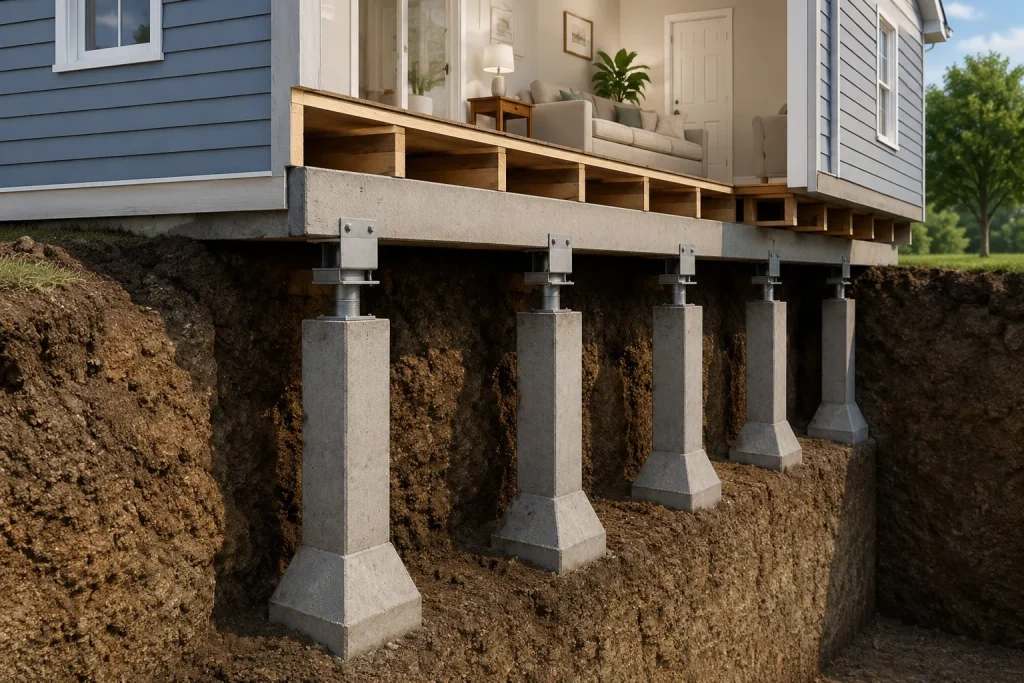
Push piers are steel support systems installed beneath a home’s foundation to stabilize it.
Think of them like deep structural supports that transfer the weight of the house away from unstable surface soil and down into stronger, more reliable soil layers deeper underground.
That’s the key idea.
Instead of relying on weak or shifting upper soil, the home essentially gets supported by stable load-bearing soil or bedrock farther below.
And honestly, that’s why push piers are considered such a long-term solution compared to surface-level repairs.
How Push Piers Are Installed
The installation process sounds intense, but it’s usually more controlled than homeowners expect.
First, sections near the affected foundation area are excavated to expose the footing. Then steel pier sections are hydraulically driven downward into the ground.
Piece by piece, the piers continue going deeper until they reach stable soil capable of supporting the structure properly.
Once that stable depth is reached, the piers are secured to the foundation using heavy-duty brackets.
In some situations, the system can even help lift portions of the home closer to their original position. Though stabilization—not dramatic lifting—is usually the primary goal.
And yes, the equipment looks serious. But crawl space specialists near me crews do this with a pretty methodical process.
Why Push Piers Work Well for Long-Term Stabilization
Here’s the reason push piers are widely used in foundation repair:
They address the actual source of settlement.
A lot of temporary fixes only deal with symptoms. They patch cracks or adjust surfaces without solving the unstable soil problem underneath.
Push piers work differently because they bypass the problematic upper soil entirely.
That matters especially in areas where:
- soil expands and contracts,
- moisture levels fluctuate,
- groundwater affects stability,
- or erosion weakens surface support.
By transferring the load deeper underground, the home becomes far less dependent on unstable near-surface conditions.
That’s the long-term advantage.
Coastal Homes Often Benefit From Push Piers
In coastal regions, foundation movement is often tied to environmental conditions.
Moisture plays a huge role. Sandy soil shifts. Clay-heavy soil swells and shrinks. Heavy rainfall changes ground stability over time.
Homes near the coast experience these cycles constantly.
That’s why push piers are commonly recommended for foundation repair in places like Hampton Roads and Virginia Beach. They provide stability in environments where upper soil conditions can remain unpredictable year after year.
And honestly, local experience matters here too. Contractors familiar with coastal soil conditions usually have a better understanding of how deep stabilization systems need to perform long-term.
Not Every Foundation Crack Means You Need Push Piers
This part’s important.
Some homeowners hear “foundation issue” and immediately assume the worst. But not every crack or uneven floor automatically means push piers are necessary.
Minor cosmetic cracks can happen naturally over time. Some homes experience small amounts of harmless settlement.
Push piers are generally used when there’s evidence of ongoing structural movement or unstable support conditions beneath the foundation.
That’s why professional evaluation matters so much. The goal isn’t to oversell a repair—it’s to determine whether the structure is actively moving and why.
What Happens After Installation?
Once push piers are installed, the foundation has a much more stable support system underneath it.
But that doesn’t mean homeowners should ignore the surrounding conditions afterward.
Drainage issues, poor grading, crawl space moisture, and water intrusion still matter. Even though the foundation is stabilized, moisture problems can continue affecting other parts of the structure if left unresolved.
The best long-term results usually come from addressing the whole environment around the home—not just one isolated issue.
Are Push Piers Permanent?
They’re designed as a long-term structural stabilization solution.
And when properly installed in appropriate conditions, they can remain effective for decades.
That’s one reason many homeowners choose them over repeated cosmetic repairs that don’t actually stop settlement from continuing.
Because eventually, most people get tired of fixing the same cracks over and over again.
FAQs
1. What are push piers used for?
Push piers are used to stabilize foundations affected by settlement or shifting soil conditions.
2. Can push piers lift a sinking home?
In some cases, partial lifting is possible, but the primary goal is usually stabilization and preventing further movement.
3. Are push piers suitable for coastal homes?
Yes. They’re commonly used in coastal regions where unstable or moisture-sensitive soil contributes to foundation settlement.
4. How long do push piers last?
When properly installed, push piers are designed to provide long-term structural support for many years.
Final Thoughts
Foundation settlement can feel overwhelming when homeowners first notice the signs. Cracks, sloping floors, sticking doors—it all creates that uneasy feeling that something underneath the house isn’t quite right.
Push piers help solve that problem at its source.
Instead of constantly repairing symptoms, they stabilize the structure by transferring the home’s weight to deeper, more dependable soil below.
And honestly, that deeper stability is what gives homeowners peace of mind long after the visible cracks stop getting worse.
