
Every RFID gaming table begins with a hidden layer of technology installed beneath the playing surface — a planar antenna array embedded in or on top of the table substrate, typically positioned directly under the primary betting areas, dealer chip tray, and drop slot. The antenna is not a single coil but a multi-loop design tuned to resonate at 13.56 MHz, the high-frequency (HF) band specified under ISO 15693 for casino chip identification.
The physical construction of the antenna array varies by manufacturer. Most commercial implementations use etched copper traces on a flexible PCB substrate, which is then laminated between layers of phenolic resin and the table’s felt surface. This sandwich construction protects the antenna from mechanical stress while maintaining consistent electromagnetic coupling with chips placed on the felt above. The antenna’s geometry — the number of loops, trace width, and resonance tuning — determines the read field’s shape and uniformity across the betting area.
An AI-powered smart casino table with integrated RFID technology. The antenna array is embedded beneath the felt, invisible to players, while AI processors analyze chip movement data in real time.
Layer 2: The RFID Reader Module
Positioned at the table’s base — either mounted inside the table leg or in a nearby equipment rack — the RFID reader module is the processing hub that drives the antenna and converts chip responses into structured data. Modern casino RFID readers are multi-protocol devices capable of supporting ISO 15693, ISO 14443, and proprietary casino chip data formats simultaneously.
The reader’s core specifications that determine table performance are:
- Read rate: Expressed as tags interrogated per second, the reader must sustain at least 500 chip reads per second to maintain accurate chip counts during peak play across all betting positions simultaneously.
- Anti-collision protocol: ISO 15693’s anti-collision algorithm allows the reader to interrogate multiple chips in its field within a single read cycle. The reader cycles through all detected chip UIDs in under 50 milliseconds, which is fast enough to complete a full table scan between individual chip placements.
- Signal isolation: Adjacent tables operating in close proximity must not interfere with each other’s read fields. This is managed through frequency channelization — the reader is assigned a specific frequency sub-band within the 13.56 MHz range, and chips are pre-configured to respond on a randomly selected channel, preventing signal collision between neighboring tables.
- Read range calibration: The reader’s output power determines the maximum read range, which must be tuned to cover the betting area without reading chips on adjacent tables. Calibration involves adjusting the RF field strength until chips placed at the table edge are detected while chips one meter away are not.
Reader power and chip stacking: A properly calibrated HF reader at standard output power (typically 0.5–2 watts ERP) can read chips stacked up to 40mm high. This means a full stack of chips placed in a betting circle is scanned completely — a critical requirement for baccarat and blackjack side bets where multiple chip stacks are common.
Layer 3: Chip Authentication and Data Transmission
When a chip’s RFID inlay responds to the reader’s interrogation, it transmits its unique identifier and any programmed data — denomination, series, casino registration code — using backscatter modulation. The reader receives this signal, decodes it, and forwards the data to the casino’s Table Management System (TMS) over an Ethernet or USB connection.
The TMS is responsible for two critical functions: chip authentication and game state reconciliation. For authentication, the TMS queries the chip database using the chip’s UID as the primary key. If the UID exists and matches the expected denomination, the chip is considered valid. If the UID is unregistered, cloned, or flagged as lost or stolen, the TMS triggers an immediate alert — typically displayed on the pit supervisor’s terminal and sent to surveillance simultaneously.
For game state reconciliation, the TMS maintains a real-time model of every active chip on the table: which chips entered the tray, which were paid out, which are in player betting positions, and which left via the drop slot. At any moment, the TMS can compute the expected chip count for the table and compare it against the reader’s live data. Any discrepancy — chips that should be present but are not, or chips present that do not belong — generates a reconciliation alert.
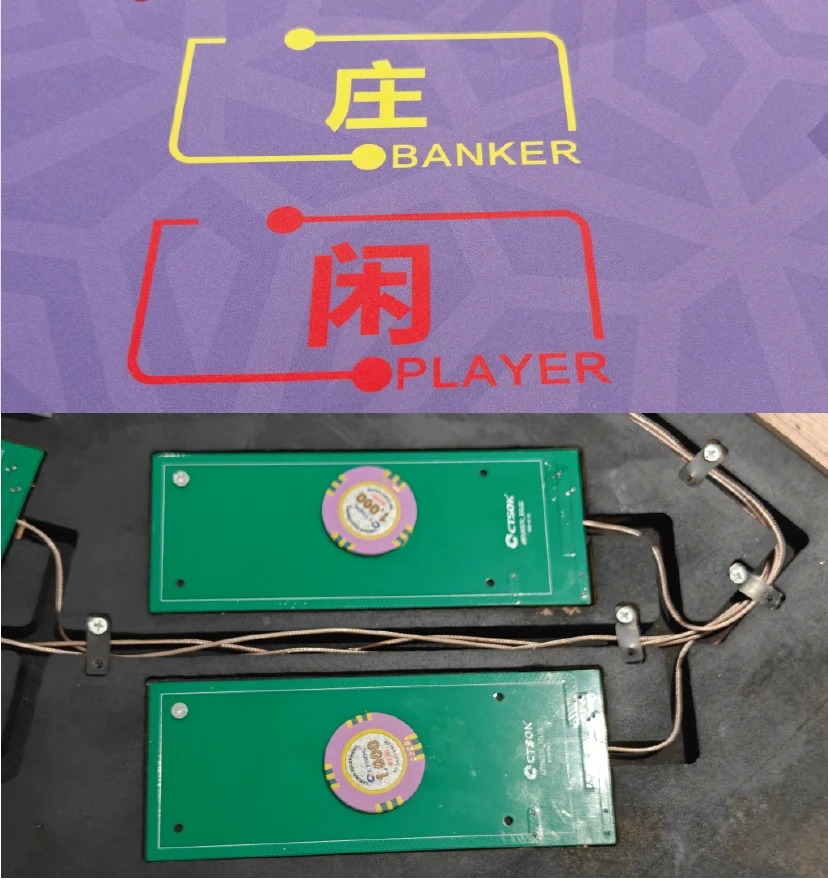
RFID smart Baccarat table in a Macau casino pit. The digital monitor above the table displays real-time chip counts and game statistics, powered by the TMS data stream from the embedded reader module.
Integration with Casino Management Systems
The TMS does not operate in isolation. It connects upward to the Casino Management System (CMS), which aggregates chip movement data from all tables across the property into a unified inventory model. This integration enables property-wide chip tracking — a chip purchased at the cage, moved to a table, won, and cashed out is tracked across every transaction in the CMS with a complete timestamped history.
The data flow from table hardware to CMS follows a standard architecture: RFID reader → table-level gateway (often embedded in the TMS) → property network → CMS application server. The gateway performs protocol translation (from RFID reader data format to CMS API format) and can apply local rules — such as immediate chip deactivation for stolen chip alerts — without waiting for a round-trip to the central server.
For casino operators evaluating table hardware, the critical integration requirement is open API compatibility. Proprietary reader protocols that only work with a single TMS vendor create long-term vendor lock-in and complicate future system upgrades. Most modern RFID gaming tables support standard communication protocols (HTTP REST or WebSocket for TMS communication), allowing operators to mix hardware from different suppliers with a unified management platform.
Frequently Asked Questions
What frequency do RFID gaming tables use and why?
RFID gaming tables operate at 13.56 MHz (high frequency, HF band) under ISO 15693 and ISO 14443 standards. HF was chosen for casino applications because it provides a read range of 10–30 cm — sufficient to cover a betting area without reading chips on adjacent tables — supports anti-collision protocols for reading multiple chips simultaneously, and is not affected by the metallic components in standard casino furniture.
Can RFID table readers be jammed or disrupted?
The 13.56 MHz HF band is relatively resistant to jamming because the reader is a tuned resonant circuit. However, a sufficiently strong nearby RF source operating at or near 13.56 MHz could create interference that degrades read performance. Most casino RFID systems include signal monitoring that detects unusual field irregularities and alerts operators to potential interference events.
How many tables can one TMS server manage?
A single TMS instance can typically manage 50–200 tables depending on the software architecture and hardware specifications of the server. High-density properties with 200+ tables often deploy multiple TMS servers, each managing a zone (pit or floor section), with a central CMS coordinating data across all zones.
Do RFID tables require special chip trays?
The dealer’s chip tray is a separate zone with its own antenna and reader, distinct from the betting area reader. Tray readers track chips entering and leaving the tray during fills, credits, and game closes. Standard casino chip trays are compatible with RFID systems — the tray base contains a separate antenna coil that reads chips in the rack slots.
What is the installation time for outfitting a casino floor with RFID tables?
For a new property, installing RFID tables involves running network cabling to each table location (if not already present), mounting reader modules, installing antenna arrays (either during table manufacturing or as a retrofit), and configuring TMS integration. A mid-size casino with 50 tables can typically be completed in 4–8 weeks with a dedicated installation team. Retrofit projects on an active casino floor take longer due to the need to work around gaming operations.
Macaumr supplies casino RFID gaming tables with integrated antenna arrays and TMS-compatible reader modules for operators worldwide. Visit Macaumr casino solutions overview for the full product range including RFID tables, chip readers, and table management hardware.
