Reading a synastry chart feels exciting the first time. Two birth charts, layered on top of each other, promise answers about why a connection feels so intense or so complicated. But synastry is a skill, not a shortcut. Many beginners, and even some experienced enthusiasts, fall into the same three traps again and again. These mistakes can turn a useful synastry chart into a source of confusion or unnecessary worry.
This article breaks down the three most common errors people make when reading a synastry chart, why they happen, and how to read a chart with more clarity and less panic.
What Is a Synastry Chart, Exactly?
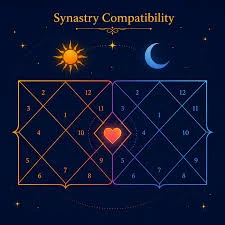
A synastry chart compares the birth charts of two people to see how their planets interact. It looks at where one person’s Sun, Moon, Venus, Mars, and other planets land in relation to the other person’s chart. The idea is simple: every planet represents a different part of a person’s personality, and when two charts overlap, those parts start talking to each other.
Some contacts feel easy. Others feel like friction. Neither type is automatically good or bad. That single idea is the foundation for avoiding the mistakes below, so keep it in mind as you read on.
Error 1: Treating One Aspect as the Whole Story
This is the most common mistake in synastry reading. Someone finds a single aspect, maybe a Mars square Pluto or a tense Saturn contact, and decides the entire relationship is doomed. Or the opposite happens: they spot one romantic Venus trine and assume they’ve found their soulmate.
A synastry chart usually contains dozens of aspects between two people. Some are minor. Some barely register in daily life. Others carry real weight. Reading only one placement and ignoring the rest is like judging an entire book by a single sentence pulled out of context.
Why this happens
Beginners often search online for “what does Venus square Mars mean in synastry” and take the first explanation as gospel. The problem is that aspects don’t exist in isolation. A challenging Mars aspect might be balanced out by a warm Moon connection elsewhere in the same chart. A relationship rarely lives or dies on one contact alone.
How to avoid it
Look at the chart as a full pattern before drawing conclusions. Check the Sun and Moon connections first, since these often shape the general sense of recognition and comfort between two people. Then look at Venus and Mars for attraction, Mercury for communication, and Saturn for long-term stability. Only after reviewing the bigger picture should any single aspect be weighted heavily.
Practical example: if a couple has a difficult Mars-Saturn square but also shares a harmonious Sun-Moon trine, the relationship likely has real emotional glue even if there’s occasional tension around drive or ambition. One aspect explains a dynamic. It doesn’t explain a person.
Error 2: Ignoring House Placements and Only Reading Aspects
Many people focus so heavily on planetary aspects that they forget the houses entirely. This is a big gap, because house overlays are where synastry becomes personal and specific.
House overlays show where one person’s planets land in the other person’s birth chart houses. This matters because it tells you which area of life gets activated. A partner’s Venus landing in your seventh house feels very different from that same Venus landing in your sixth house, even if the aspect between the actual planets is identical.
Why this happens
Aspects get more attention online because they’re easier to summarize in short articles or generic compatibility tools. House placements require looking at both people’s exact birth times and doing more careful comparison work, so they often get skipped.
How to avoid it
Always check where a partner’s planets fall in relation to the houses, not just the signs. Here’s a simple way to think about it:
- A partner’s planets in your first house often affect how you see yourself when you’re around them.
- Planets in your fourth house often touch feelings about home, family, and long-term roots.
- Planets in your seventh house frequently point toward partnership potential and how equal the relationship feels.
- Planets in your eighth house can bring intensity, deep intimacy, or a sense that the connection runs deeper than casual dating.
Skipping this step means missing half the picture. A synastry chart built only from aspects, without house context, tells you how two people’s personalities interact, but not where in life that interaction shows up. Birth chart compatibility work that ignores houses is only half-finished.
One important note here: house placements require an accurate birth time. Without it, house overlays can’t be calculated reliably, and Moon placement accuracy also suffers. If a birth time is missing or uncertain, it’s worth being upfront about that limitation rather than guessing.
Error 3: Expecting the Chart to Predict a Guaranteed Outcome
This is perhaps the most emotionally loaded mistake. People often read a synastry chart hoping for a verdict: will this relationship last, is this person “the one,” is this a soulmate connection. When the chart shows hard aspects, anxiety spikes. When it shows soft aspects, people relax completely, sometimes too completely.
Astrology, including synastry, is a belief-based practice with a long cultural history. It is not a scientific method for predicting the future, and no chart, no matter how detailed, can guarantee how two real people will treat each other, communicate, or grow over time.
Why this happens
Relationships come with uncertainty, and uncertainty is uncomfortable. A chart full of numbers and symbols can feel like it offers certainty in a way that real life doesn’t. This is part of what makes astrology compatibility appealing, but it’s also where the biggest misunderstanding sits.
How to avoid it
Treat a synastry chart as a tool for understanding dynamics, not a prediction machine. A chart with several challenging aspects doesn’t mean a relationship is destined to fail. It often means the couple will need more patience, better communication, or clearer boundaries in specific areas. A chart full of easy, flowing aspects doesn’t guarantee smooth sailing either. Comfort without effort can sometimes lead to stagnation rather than growth.
Practical example: a couple with a tense Mars-Pluto square in their synastry chart might experience intense attraction and occasional power struggles. That doesn’t spell disaster. It signals that self-awareness and open conversation will matter more in this particular pairing. On the other hand, a couple with many soft trines might get along effortlessly but should still put in conscious work to keep the connection from feeling too passive over the years.
A synastry reading works best as a mirror and a conversation starter, not a fortune-telling tool. It can help two people put language to patterns they’ve already noticed, like why the same argument keeps resurfacing or why certain topics always feel easy to discuss.
Bringing It Together, Reading a Synastry Chart the Right Way
Avoiding these three errors comes down to one habit: slow down and look at the full context. Don’t stop at the first aspect that stands out. Don’t skip house placements just because they take more effort to calculate. And don’t expect any chart, however detailed, to hand over a guaranteed outcome about a relationship’s future.
A well-read synastry chart considers aspects, houses, and the overall pattern between two birth charts together. It looks at Sun and Moon contacts for emotional recognition, Venus and Mars for attraction, Mercury for communication style, and Saturn for long-term structure. It weighs house overlays to understand which life areas get activated. And it treats the whole thing as a framework for insight, not a script for what has to happen.
Whether someone is comparing charts for a new romantic connection, checking in on a long-term partnership, or even looking at friendship or family dynamics through relationship astrology, the same principle applies. A synastry chart offers language and perspective. It doesn’t offer certainty, and it was never meant to.
