
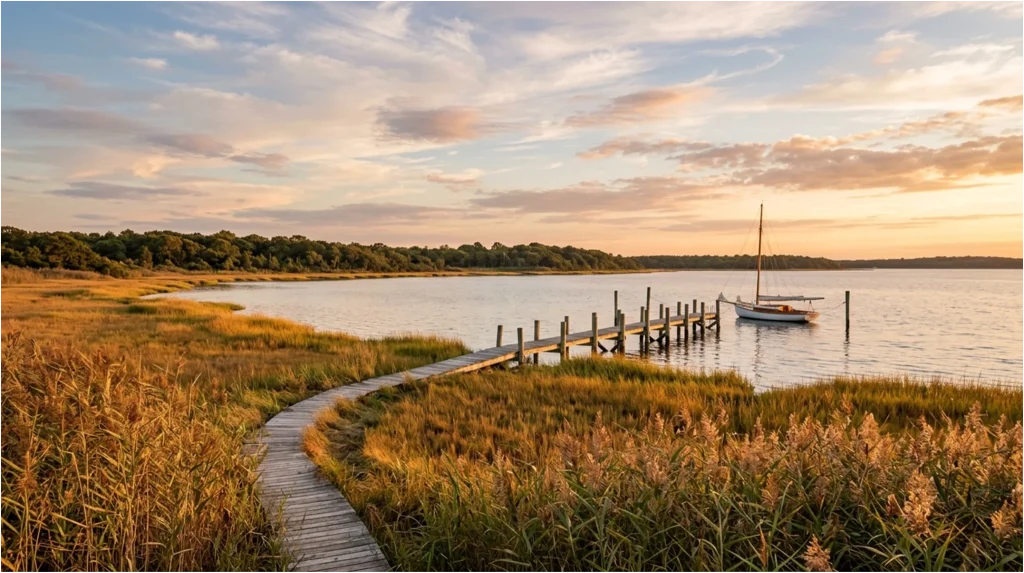
Long Island’s eastern tip is a study in contrasts, quiet farmland brushing against the Atlantic and a working waterfront that still keeps its own hours. Travelers who linger past the postcard views find a region shaped by tides, harvests, and centuries of maritime tradition. Here is a seasonal primer for visitors who want more than a weekend snapshot.
A landscape shaped by water and farmland
The east end unfolds as two forks separated by the Peconic Bay. The South Fork holds the wide ocean beaches most people picture when they think of the region, while the North Fork bends toward the Sound in a patchwork of vineyards, orchards, and small hamlets.
Elevation rarely rises above a low bluff, so the horizon feels immense. Salt hay meadows, kettle ponds carved by glaciers, and pine barrens fill the spaces between towns. That mix of terrain gives each village its own texture, from Southampton’s manicured streets to Greenport’s harbor-front bustle.
The bays themselves are shallow and remarkably productive. Bay scallops, hard clams, and eastern oysters have supported baymen for generations, and pockets of eelgrass still shelter the juvenile fish that keep the estuary in balance. Understanding that ecology helps visitors appreciate why so many restaurants proudly source within a short drive.
Where to base yourself for a slower pace
Choosing a home base matters more than the calendar month. Travelers who want quiet mornings often gravitate toward Sag Harbor or Cutchogue, where curated stays near the shoreline put them within walking distance of harbor cafes, farm stands, and short trails that trace the edges of the bays.
Renting a house rather than booking a hotel room tends to change the rhythm of a trip. It allows for cooking with local produce, entertaining friends who drive out for the day, and settling into a neighborhood long enough to notice the sound of the surf at low tide.
A calendar that rewards patience
Spring arrives late here, held back by cool ocean air, but daffodils fill the fields by early April. Summer belongs to swimmers and the farmers markets that anchor most weekends. Fall brings pumpkin harvests, wine releases, and clearer light. Winter empties the roads and reopens the coastline to walkers and shellfish diggers.
Weekday visits, even in July and August, feel dramatically different from Saturdays. Restaurants relax, parking loosens, and beach access becomes easier. Locals often recommend a Sunday through Wednesday stay to travelers who prefer a quieter, more contemplative pace along the water.
Local food, culture, and the working waterfront
The North Fork’s wine country traces its roots to the 1970s, when the region’s first vineyards began experimenting with cool-climate varietals. Today, more than thirty wineries share the peninsula with oyster farms, cheese makers, and roadside stands that sell whatever the season happens to provide.
Culture runs deep here as well. Small museums document whaling voyages, colonial farming, and the Shinnecock and Montaukett communities whose history predates every European settlement on the island. Concerts, farm dinners, and open studios rotate through the calendar and add texture to any visit.
Getting around without losing the pace
The Long Island Rail Road reaches Greenport and Montauk, and jitneys run frequently from Manhattan during warmer months. Once out east, a car is helpful for exploring back roads, but bicycles and beach cruisers cover most in-town errands and reveal corners that highways skip past entirely.
Ferries connect Greenport to Shelter Island, a short crossing that opens up quiet nature preserves and low-traffic lanes ideal for cyclists. Farther east, another ferry links Sag Harbor’s shore to the same island, letting travelers loop the region without doubling back over congested summer roads.
Conclusion
The east end rewards visitors who slow down and follow local rhythms rather than a checklist. Give yourself extra hours to wander a village, revisit a beach at dusk, or drive quiet back roads with no fixed destination. The region tends to reveal itself gradually, one tide and one harvest at a time.
